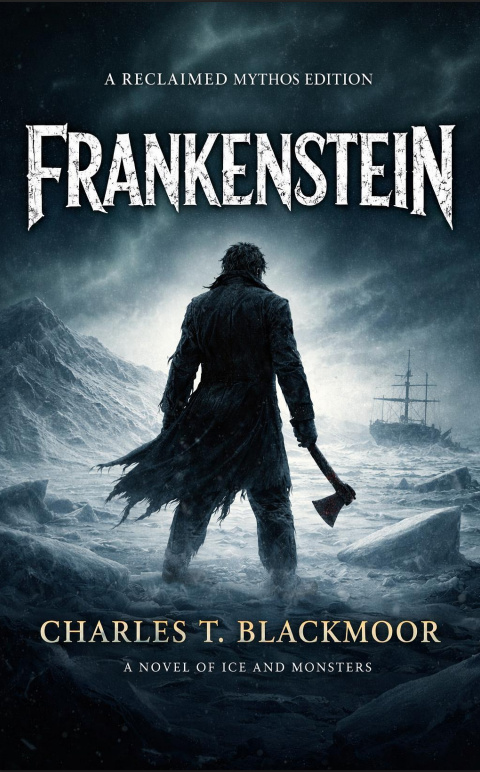
Chapter 1 — Ice-Locked
June 12. Latitude 61° 20′ N. Wind WNW. Sea plain. Spirits high.
June 19. Ice first sighted at dawn—thin sheets, like skin. Hull makes a sound I do not like.
June 27. The compass begins to misbehave. Not wildly—just enough to remind a man the world does not owe him straight lines.
July 2. Entered heavier ice. Reduced sail. Men speak less.
It is an old mistake to believe the Arctic announces itself with drama. It does not. It arrives by repetition: the small inconvenience that returns the next day larger, and the next day larger still, until it has become a sentence.
A line of ice at the horizon.
A channel that narrows.
A change in how the ship answers the rudder.
A day without gulls.
A night without any sound but pressure moving under your feet.
Men talk about the North as if it is a thing you can conquer—flags, firsts, glory. But the North is not an enemy with a face. It is conditions. It does not negotiate. Up there, an error is not argued with. It is collected. It is deducted.
I did not come north for romance. I came because routine can hollow a man out more cleanly than any storm. I wanted a point on the map that carried my name, because I had begun to suspect that without some mark made against the world, a man’s life can dissolve into quiet labor and be forgotten by the very people who benefited from it.
That is not bravery. It is appetite.
The ship was provisioned for months. The crew was chosen not for talk, but for endurance. I rejected three men who were strong enough but laughed too easily. Laughter is useful on warm water; in ice it can thin into hysteria by degrees, and hysteria spreads faster than cold.
We carried instruments—chronometers kept like relics, a sextant handled with care that bordered on superstition, needles and magnets, bottles for specimens. The more I prepared, the more certain I became that preparation was a kind of bargain with fate.
It is not.
By mid-July the sea had turned thick with floes. Some were flat as tables. Others rose in ridges—split and re-frozen—like ruin stacked on ruin. The ship pushed into channels that existed at dawn and were gone by noon. We learned to read the ice by sound.
A low, steady groan meant patience.
A sharper crack meant danger.
There are noises that make every man on a ship stop moving at once—not because he is told, but because the body understands before the mind does that the world is shifting.
On the morning of July 31, the air was unusually clear. The sky had that hard brightness that comes when the cold has stripped moisture from everything. The light did not feel kind. It felt clinical.
At 08:20 the lookout called down from the foremast.
“Movement on the ice!”
At first I assumed bear. That would have been ordinary enough—ordinary, at least, in a place where the ordinary can kill you.
I took the glass and steadied it against the rail.
It was not a bear.
It was a sledge moving over the ice at a distance that made scale uncertain. The figure guiding it was upright—tall, wrapped in furs. But the posture was wrong. Not the easy authority of a man behind dogs on a practiced route, but the strained lean of someone dragging a burden too heavy to admit.
I waited for the dogs to appear.
They did not.
The sledge moved as if pulled by a force invisible from our angle. The figure did not look toward the ship. It did not hesitate. It traveled north with a kind of intention that felt impersonal—as if it were being carried to its work.
Men gathered along the rail. No one spoke loudly. Some sights silence a ship faster than discipline ever could.
“Is it a native?” one of them asked.
“Too far to tell,” I said.
It was not the question that disturbed me. It was the instinct beneath it—the need to name what we saw, to file it under something known, something that fits inside language.
The figure passed behind a ridge of ice and was gone.
A ship at sea is always surrounded by uncertainty. That is part of the trade. But this was a different strain of unease—not weather, not hunger, not even the fear of being trapped. It was the unease of seeing something placed wrong in the world, like a shadow cast where it should not be.
At 14:10 the ice offered us a second event.
This time it began not from above, but from the deck—one of the men pointing into a broken lead between floes.
“A man!”
I saw him at once: a dark shape on the ice, moving badly. Not walking so much as advancing by refusal to fall. He was close enough now that the human form was undeniable. He stumbled, caught himself on his hands, rose again. Each movement looked expensive.
We launched a boat with difficulty. The lead was narrow and crowded with slush. Oars struck ice. The sound traveled too far in that empty air.
When we reached him he did not resist, but he did not help us either. His limbs moved with the dull lag of a body denied warmth too long. We dragged him into the boat. His clothing was stiff with frozen brine. His hair held ice like glass. His skin—where it showed—was the color of old parchment.
He was alive, but only just.
We brought him aboard. The men expected him to speak. Gratitude. Relief. The quick human exchange that turns rescue into a story you tell later with pride.
He gave them none of it.
His eyes opened—gray, bright with fever or with something steadier than fever—and he looked past us, past the ship, past the men, as if the present scene held no authority over him.
Then his lips moved, and the words came as if scraped out of his throat.