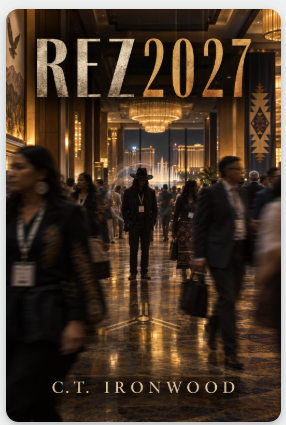
Las Vegas had already been awake for hours by the time REZ started pretending Monday morning belonged to it. That was one of the useful things about Caesars Palace. You could bring four thousand Native business owners, tribal leaders, federal people, bankers, lawyers, artists, contractors, politicians, consultants, and economic-development people into one building, and the casino still had enough going on to act unimpressed.
At seven-thirty in the morning, slot machines were flashing under lights designed to make time irrelevant. A man in yesterday’s shirt sat alone with a drink that might have been coffee. Two women in heels walked past carrying shoes in their hands. Somebody somewhere had already won something. Somebody else had already lost more.
And through all of it came the first REZ badges of the morning. Not many at first, then more. Ribbon shirts, sport coats, tribal enterprise polos, federal-agency lanyards, Native-owned company logos. People carrying coffee, folders, laptops, tote bags, phones, and the particular expression of someone trying to remember whether the person walking toward them was an old friend, a potential partner, or somebody whose email they had ignored since November.
REZ 2027. March eighth. First day.
The theme that year was Sovereignty in Action. The words were on signs near registration and on screens mounted where people waiting in line could read them often enough to begin believing they had thought of the phrase themselves. People at conferences like phrases that can carry more than one meaning without requiring anybody to choose between them too early. Sovereignty was one. Opportunity was another. Partnership could carry almost anything if the room wanted it badly enough.
By eight, registration had begun producing its own weather. Badges printed. People stopped in the middle of traffic because somebody shouted their name. Handshakes became hugs, hugs became introductions, and introductions became, “You two need to know each other.” Somebody from Oklahoma was explaining to somebody from Alaska why they absolutely needed to meet somebody from Minnesota who had not yet arrived. A tribal chairman stood near a federal procurement officer while both tried to remember where they had met before. Three young men in new suits moved past wearing conference badges high enough to be read from Wyoming. One of them had already filled both hands with promotional material from tables that technically were not open yet. There are people who collect conference giveaways like evidence. Nobody stops them.
The Trade Show itself would not open until that evening. During the day, exhibitors were still setting up: crates, cases, rolled banners, boxes opened with hotel scissors because somebody had packed everything except a knife. Men knelt under tables trying to run electrical cords where decorators had told them they were not supposed to. Women stood with hands on hips deciding whether a ten-foot backdrop was leaning or whether they were simply tired. The hallway outside the hall smelled faintly of carpet, coffee, cardboard, and ambition.
The Art Market was different. The Native Art Market would open later that morning, and some vendors were already there arranging their tables. Jewelry under glass. Beadwork, prints, clothing, carvings, basketry. Things made recently, things made in old ways, and things made in new ways that people would later insist were old. The usual argument between tradition and price tags had not yet started. It would. It always did.
Martin Greyhorse walked past the registration area carrying coffee that had cost enough to deserve a better origin story. He was seventy-one, maybe seventy-two. He had quit correcting people.
Marty had been attending REZ long enough that he no longer remembered the first year clearly. He remembered places, hotels, certain speakers, certain deals. Certain men who had arrived with nothing and returned ten years later wearing watches that needed their own insurance. He remembered tribal businesses nobody believed would survive that became large enough to sponsor receptions, and others that entered REZ with booths twenty feet wide and disappeared before the next one. Conferences kept their own kind of history, mostly in people.
He had spent years in tribal economic development, then ran a manufacturing enterprise, then consulted, then retired badly. Retirement lasted eleven months. After that he joined two boards and started telling people he was “mostly done,” which fooled nobody who knew him.
He had no presentation that morning. No booth, no matchmaking appointment, no reason to hurry. That gave him an advantage. He could watch.
He stopped near a column beyond registration and took a drink of coffee. That was when he first saw the man.
Nothing announced him. That was the part Marty remembered later. No strange feeling, no noise dropping away, no light changing. The man was simply standing near the far edge of registration. Maybe fifty, maybe younger. Dark jacket, plain shirt, REZ badge. Average height, average build. The sort of face designed to make a person say later, I’d know him if I saw him again, without having the slightest idea whether that was true.
The man was watching people arrive. Not staring. Watching.
Marty had known salesmen, investigators, federal auditors, elected officials, gamblers, recruiters, men looking for investors, and men looking for somebody else’s wife. He knew the difference. This man was not searching for somebody. He was learning the room.
His attention moved slowly. A woman from a tribal construction company. Two men from a bank. A young couple arguing quietly over a registration confirmation. An older man carrying an artisan badge. A group of federal employees heading toward the meeting rooms. He watched each for a moment and moved on. Never their badges. Their faces.
Marty took another drink. The man turned, not toward Marty but toward an opening elevator farther down the corridor, and walked away. Marty watched until the crowd took him.
Then somebody slapped him on the shoulder. “Greyhorse.”
Marty turned. Henry Littlecrow stood there grinning like he had personally arranged the summit.
“You’re still alive.”
“Disappointing several people.”
Henry laughed and pulled him into the half-hug older men use when full affection feels too theatrical before breakfast. “You doing Buy Native today?”
“No.”
“You got nothing to sell?”
“I got plenty to sell. I’m just tired of buyers.”
“That sounds unhealthy.”
“So does matchmaking.”
Henry looked toward the signs directing people to Monday’s one-on-one Buy Native meetings. “You always liked that stuff.”
“I liked it when people called it appointments.”
“They improved the name.”
“They made it longer.”
Henry laughed again, and they started walking toward the meeting area.
By nine, Buy Native matchmaking was underway. That part of REZ always had its own energy. Small businesses sitting across from federal buyers. Native companies meeting prime contractors. People making ten-minute introductions they had practiced for two weeks and forgotten in the elevator. Capabilities, past performance, NAICS codes, certifications, capacity, geography, bonding. One meeting ending badly while the next table closed something that might turn into real money six months later. Promises everywhere. We will follow up. Send me your capability statement. I’ll introduce you. We have something coming. Call me next week. Let’s set something up.
Marty walked through once because Henry insisted. He watched one younger woman from a tribally owned construction firm finish a meeting with a federal buyer. She stood, shook hands, smiled, and waited until she was ten feet away before looking at her coworker and saying, “That was nothing.”
The coworker said, “That was absolutely nothing.”
“Good. I thought I was getting cynical.”
Marty liked both of them immediately.
A man at another table said, “We’re committed to building relationships in Indian Country.” Marty kept walking. He had heard that sentence since before half the room was born.
At ten-twenty, the Native Art Market was almost ready to open. A few attendees had already started drifting toward it because conference people treat posted opening times as suggestions whenever merchandise is visible. Vendors made final adjustments. They straightened tablecloths, moved jewelry half an inch, and changed prices they had already decided three times.
At one table near the middle, a woman named Nora Birdsong unpacked the last object from an old bath towel. It was not especially beautiful. That bothered her. Most things she brought to REZ had an obvious reason to be there. This did not.
It was a little larger than her palm. Dark, heavy for its size. Not quite stone. Not quite metal either, at least not in any way she understood. One surface curved. Another had what might have been a groove, except grooves usually went somewhere. This one stopped.
She had found it back home the previous summer after rain opened part of an old bank behind property that had belonged to her grandfather’s brother. Not a burial place, not ceremonial ground, nothing like that. Old junk had come out of there before: rusty hinges, bottle glass, a spoon, a piece of harness hardware, somebody’s broken coffee cup. The object had been caked in hard dirt and something darker that might have been mineral stain. Nora almost threw it into a bucket with the rest. Instead she kept it.
Months later she cleaned it. Water first, then a soft brush, then more than that, though she would later become uncertain exactly how much more. Whatever had covered it came off reluctantly. Underneath was the mark. Not carved exactly, not painted. A shape. Three lines meeting around an empty center.
Nora had shown it to three people. One said old tool part. One said decorative. A third told her to quit asking questions if she planned to sell it. That had seemed practical. So she brought it to Las Vegas, not as anything sacred, not as anything identified, just an old strange thing somebody might want to put on a shelf.
She set it near the back of the table, looked at it, and turned it slightly. She did not like the way the mark faced the aisle. She turned it back.
A man standing nearby said, “How much?”
Nora looked up. He was pointing to a bracelet, not the object.
“Two twenty-five.”
He picked it up. By the time she finished talking to him, she had forgotten the dark object completely.
At ten-thirty the market opened. People came in. No bell, no ribbon, no change in the lights. Just attendees moving toward tables.
Marty entered maybe fifteen minutes later because he had promised someone he would look for a gift and had learned that waiting until Wednesday meant choosing between what nobody wanted and what required a second mortgage. He moved slowly. He stopped at one jewelry table, then another, spoke to two people he knew, and pretended not to hear one person call his name because some conversations require scheduling even when they are accidental.
Halfway down the aisle he saw the man again. Dark jacket, plain shirt, same face, standing at Nora Birdsong’s table. He was not looking at the jewelry. He was looking at the dark object near the back.
Marty stopped. The man leaned closer but did not touch it. Nora was helping another customer and had not noticed him. For several seconds he remained perfectly still. Then he looked up, not at Nora but at the people moving behind her. His gaze passed across the aisle. For one moment Marty thought it would settle on him. It did not. The man turned and walked away.